

The Importance of Acknowledging and Digesting Our Feelings
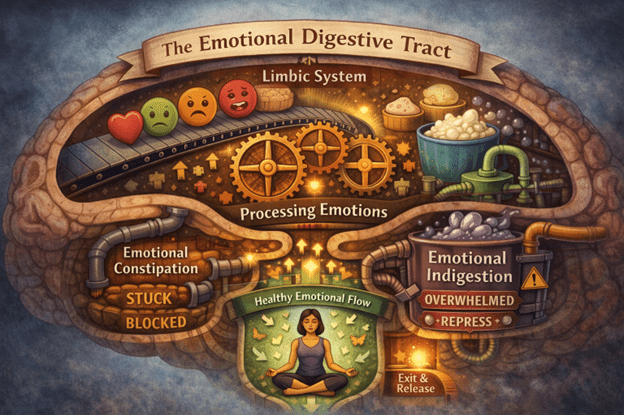
The limbic system, located in our midbrain, is often referred to as our emotional digestive tract. In the same way that we take in food and then digest it, we experience emotional feelings all day, some small, some large, some even overwhelming. Like food we’ve eaten, some of these feelings can be difficult to digest. At times we may deny these feelings, or try to push them down, or away, this can lead to emotional indigestion or even emotional constipation – we feel stuck, blocked, or in limbo. In case you are reading this and you are thinking “yes I do this,” you are not alone, this is common among humans.
Gabor Maté, a world-renowned expert on addictions and the author of In the Realm of Hungry Ghosts (2010), posits how this basic human pursuit of emotional regulation drives the development and the maintenance of addictive behaviors. Addicts desperately seek and consume substances, or engage in repetitive, problematic behaviors, to escape emotional or physical pain or discomfort, and/or to seek pleasure.
Addictions are an extreme example and a powerful expression of how the homeostatic drive to seek pleasure and to avoid pain can create and support a wide range of difficult, problematic and very resistant patterns of behavior. Addictions tend to be highly resistant to most interventions, even as individuals can be aware that they are acting in a way that is dangerous and destructive.
When we are effectively emotionally regulated, we feel safe enough, and capable enough, to be present with our embodied emotional experience with acknowledgement and acceptance. With a minimum of resistance and struggle, we can navigate even intense emotional energies, because we feel safely able to tolerate the experience. For example, following a painful loss, we can take some time to mindfully identify and then witness the physical, bodily sensations of grief. In the absence of a struggle against those feelings, we can witness and accept the feelings of sadness and loss. While breathing slowly and deeply, we can allow the emotions to move through our body so they can gradually be processed, digested and released.
To feel emotionally healthy, that is, to have a healthy emotional digestive tract, our emotional experiences must be acknowledged, processed (digested), and accepted for what they are. Having a healthy emotional digestive tract feels good and allows us to access and receive the essential information and personal learning that emotions can provide.
When emotional energy can move unblocked and be witnessed, it passes through the body’s systems and reaches a certain degree of completion. In some way, it has accomplished something; it can leave us with a deeper connection and understanding with ourselves.
The need for, and the pursuit of, emotional regulation influences much of our human functioning. We instinctively, reflexively, seek to minimize and avoid physical and emotional pain and discomfort, and we naturally seek to find, maintain, and prolong positive, pleasurable experiences. Emotional regulation is an expression of a fundamental homeostatic process that supports basic life functions in most animal species.
Mindfulness-Based Emotional Processing (MBSEP), a method developed by Robert Weisz, PhD, teaches us how to work with our emotions in a simple and accessible way. With MBSEP, rather than focus on the story and the external factors, which only serve to draw us further into the details and the drama of the story, we, instead, intentionally choose to attend to the actual emotions that are moving us and affecting us.
More specifically, we bring attention and awareness to the felt physical qualities of the emotional experience, so that we can process and digest its emotional energy and be receptive to the important emotional messages that it carries.
Acknowledging and feeling our emotions as tangible, physically discernible phenomena in the body allows us to process them so we can feel them more clearly and directly. When we can mindfully witness our feelings and their physical expression, they can be processed and “digested” through the ancient, non-cognitive animal intelligence that dwells within the human body.
MBSEP gives us a way of being fully present with the energy and the physical manifestation of our emotional experiences, so that we can acknowledge, accept, and process that emotional energy through the body’s intrinsic animal intelligence.
For example, if we sense that we are afraid of speaking up in a group and take just a few minutes to curiously witness (while breathing slowly and deeply) the sensations of fear in the body (and not struggling against the fear), we will find that the intensity of fear is likely to diminish. We will be able to sense that change very directly as it happens in the body.
People who practice MBSEP share that they feel more in tune with themselves, more in the flow of life. Sometimes that comes with joy, sometimes with sadness, and sometimes the flow is just physical sensation. Over time, the practice of MBSEP can bring a more conscious and respectful relationship with our emotional life.
CONTACT US TODAY!
505-242-6988

The Evolution Group Incorporated is a private counseling firm that has built its practice around the core values of integrity, authenticity, safety and honoring individuality. We work with individuals, couples and families to empower the wholeness that already lies within them
The Evolution Group, Inc.
218 Broadway Blvd SE
Albuquerque, NM 87102
Front Desk Hours:
Monday to Thursday: 9:00am-6:00pm
Friday: 9:00am-5:00pm
Appointment Required
Phone:?505-242-6988
Email:?[email protected]


